
EcoNir guide for Indian + global homes (no greenwashing, just clarity)
Bamboo toothbrushes, wooden cutlery, “eco” chopping boards… they feel like the right choice and honestly, I love the warmth they bring to a home. But sustainability isn’t a vibe. It’s a full story: where it came from, how it was made, how long it lasts, and what happens after.
So, are bamboo & wooden products really sustainable? ✅ Sometimes yes. ⚠️ Sometimes not at all. Let’s break it down simply.
Table of Contents
The real meaning of “sustainable” (quick checklist ✅)
A product is actually sustainable when it’s:
- Responsibly sourced (no illegal logging, no forest destruction)
- Low-impact to make (less energy, fewer toxic chemicals)
- Durable (used for years, not weeks)
- Repairable / compostable / recyclable at end-of-life
- Ethical (fair labor, safer supply chain)
If a bamboo product fails #2 or #3, it may be less sustainable than you think.
Bamboo: fast-growing hero… with hidden catches 🎋
Why bamboo is often sustainable ✅
- Bamboo grows very fast and can regrow after harvesting (depending on species and management).
- It can reduce pressure on slow-growing forests when sourced responsibly.
- Many bamboo items feel “low plastic” and minimalist.
Where bamboo turns “not-so-green” ⚠️
1) Bamboo isn’t always “just bamboo.”
A lot of bamboo products are laminated (strips glued together). That glue/resin can reduce compostability and introduce chemical concerns (especially in low-quality products).
2) Transport emissions can be high.
If it’s grown in one country, processed in another, and sold globally, the footprint grows. (Not a deal-breaker, but worth noticing.)
3) “Bamboo fabric” is often chemical-intensive.
Many “bamboo” clothing/bed sheets are actually viscose/rayon made from bamboo, which may involve heavy chemical processing. It can still be comfortable—but it’s not automatically eco.
EcoNir takeaway:
🎋 Bamboo is best when it’s local-ish, minimally processed, and built to last.
Wood: sustainable when certified… destructive when not 🌳
Why wood can be a great sustainable choice ✅
- Wood is renewable when forests are well managed.
- Long-life wood products (furniture, boards) can spread impact over many years.
- Solid wood is often easier to repair than plastic.
Where wood becomes unsustainable ⚠️
1) Deforestation + illegal logging are real issues.
If sourcing is unclear, “wooden” can hide harmful supply chains.
2) Chemical finishes matter.
Paints, varnishes, and treatments can add toxins and reduce biodegradability.
3) Composite wood = extra glue.
Items like MDF/plywood/particleboard use adhesives and may off-gas depending on standards and quality.
EcoNir takeaway:
🌳 FSC/PEFC-certified wood + simple finishes = much safer bet.
Learn more about responsible forestry standards from FSC (Forest Stewardship Council) certification, which promotes sustainable forest management worldwide.
Bamboo vs Wood: what’s greener overall?
Here’s a practical view assuming average household use.
| Factor | Bamboo 🎋 | Wood 🌳 |
|---|---|---|
| Renewability | ⭐⭐⭐⭐⭐ (very fast growth) | ⭐⭐⭐⭐ (slower, but renewable) |
| Processing impact | ⭐⭐–⭐⭐⭐⭐ (varies a LOT) | ⭐⭐⭐–⭐⭐⭐⭐ (varies by finish) |
| Durability | ⭐⭐⭐⭐ (good if quality) | ⭐⭐⭐⭐–⭐⭐⭐⭐⭐ (often excellent) |
| End-of-life | ⭐⭐–⭐⭐⭐⭐ (glues reduce composting) | ⭐⭐⭐–⭐⭐⭐⭐⭐ (solid untreated wood is best) |
| Best use-cases | light tools, decor, some boards | furniture, boards, utensils, long life items |
The “greenwashing” traps to watch for 🚨
If you remember just these, you’ll avoid most bad buys:
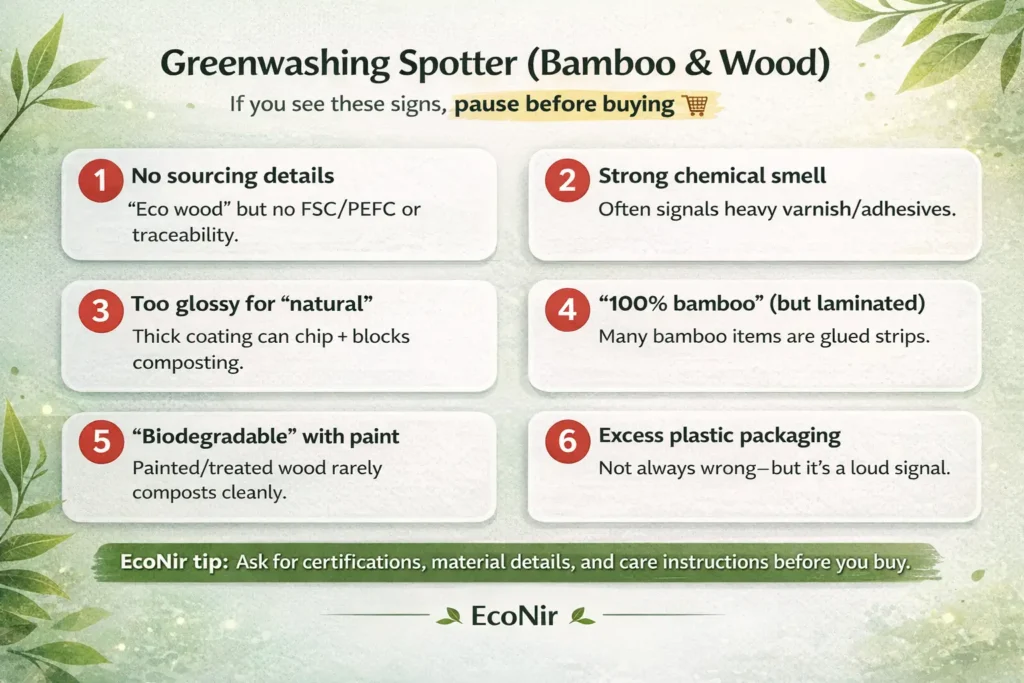
Greenwashing Spotter ( Bamboo & Wood )
⚠️ Trap 1: “100% natural” but heavily coated
A shiny bamboo board with thick varnish may last, but it’s not compostable and may chip with time.
⚠️ Trap 2: “Eco-friendly bamboo” but glued like plywood
Laminated bamboo is common—look for quality + food-safe adhesives where possible.
⚠️ Trap 3: “Bamboo cotton” that’s actually viscose
If it says bamboo viscose / rayon, it’s a regenerated fiber. Not automatically bad—just not “raw bamboo.”
⚠️ Trap 4: “Reusable” items that die quickly
A bamboo straw you hate cleaning and stop using is less sustainable than a steel straw you love.
Best picks (what I personally recommend) ✅
If you want choices that usually work for both India + global readers:
✅ Most sustainable bamboo/wood products (when well made)
- Solid wood cutting board (FSC/PEFC if possible)
- Wooden spatulas/ladles with minimal coating
- Solid wood furniture (built to last + repairable)
- Bamboo baskets / organizers (low chemical, long life)
- Bamboo toothbrush (only if you’ll actually use it fully!)
⚠️ Be careful with these
- Cheap bamboo boards (often crack + heavy glue)
- “Bamboo fabric” without transparency (viscose process)
- Strong-smelling wooden items (could indicate heavy chemicals)
- Painted kids’ wooden toys from unknown brands (check safety standards)
India-specific note 🇮🇳 (why “local” matters)
In India, bamboo and wood can be genuinely sustainable when sourced from responsible makers—especially when:
- Bamboo is sourced from regions where it’s traditionally grown (parts of Northeast India, for example)
- Wood is from legal, traceable supply chains
- You buy from local carpenters/artisans (repair + longevity go up)
Also: mango wood (often a byproduct of orchard trees) can sometimes be a better story than exotic hardwood—if it’s responsibly processed and durable.
EcoNir’s “Buy Smart” checklist ✅ (copy this into your notes)
Before purchasing bamboo/wood products, ask:
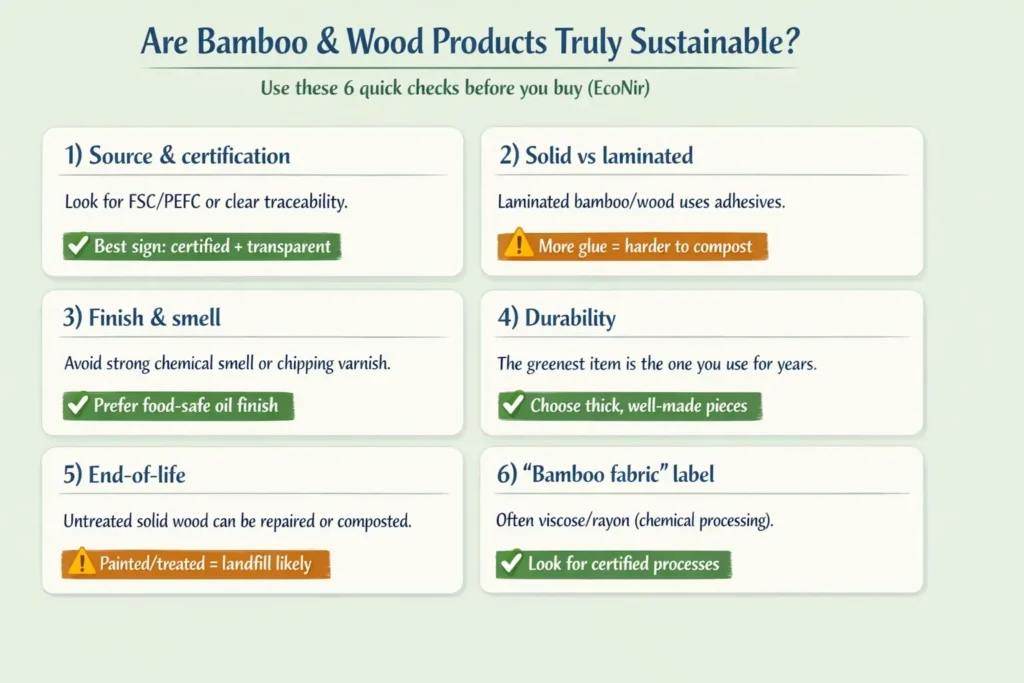
- Is it solid or laminated?
- Any certification (FSC/PEFC) or clear sourcing info?
- Does it have a strong chemical smell? (skip)
- Will I use it for 2+ years realistically?
- Can it be repaired or re-oiled?
- Is it packed in excess plastic? (ironic but common)
Before making your next sustainable purchase, explore our complete comparison: Wood vs Plastic: Which Is Actually Better for Health & Environment? covering indoor air quality, microplastics, and long-term environmental cost.
FAQs
1) Is bamboo always more sustainable than wood?
No. Bamboo grows fast, but many bamboo products are glued/laminated and heavily processed. Certified, solid, durable wood can be greener.
2) Are bamboo cutting boards safe?
Often yes, but quality matters. Prefer boards with food-safe finish, minimal glue smell, and good thickness. Replace if deep cracks form.
3) Is “bamboo fabric” eco-friendly?
Not automatically. Many are bamboo viscose/rayon, which can involve chemical processing. Look for transparency and better-process certifications.
4) What’s the most sustainable option for kitchens?
Usually: steel + glass for storage, and solid certified wood for boards/utensils—because it balances durability and lower chemical exposure.
5) How can I check if wood is really FSC/PEFC certified?
Look for the FSC or PEFC logo on the product/box and a license or certificate code (often starts with FSC® C…). If it’s missing, check the brand’s website for sourcing details—vague claims like “eco wood” without proof are a red flag.
6) Can bamboo/wood products be composted at home?
Only untreated, unpainted, unvarnished solid wood/bamboo is suitable for composting. Items that are laminated, glued, resin-coated, or painted usually shouldn’t go into home compost (they may not break down safely).
7) Are bamboo toothbrushes actually eco-friendly?
Partly ✅ The handle can be lower-plastic, but the bristles are usually nylon, which must be removed and trashed. It’s still a better option than a full plastic brush for many people—but it’s not 100% compostable.
8) How do I make bamboo/wood products last longer (so they’re truly sustainable)?
Keep them dry between uses, avoid long soaking, and don’t put them in a dishwasher unless the brand explicitly says it’s dishwasher-safe. For boards/spoons, occasional food-safe oiling helps prevent cracking and extends life.
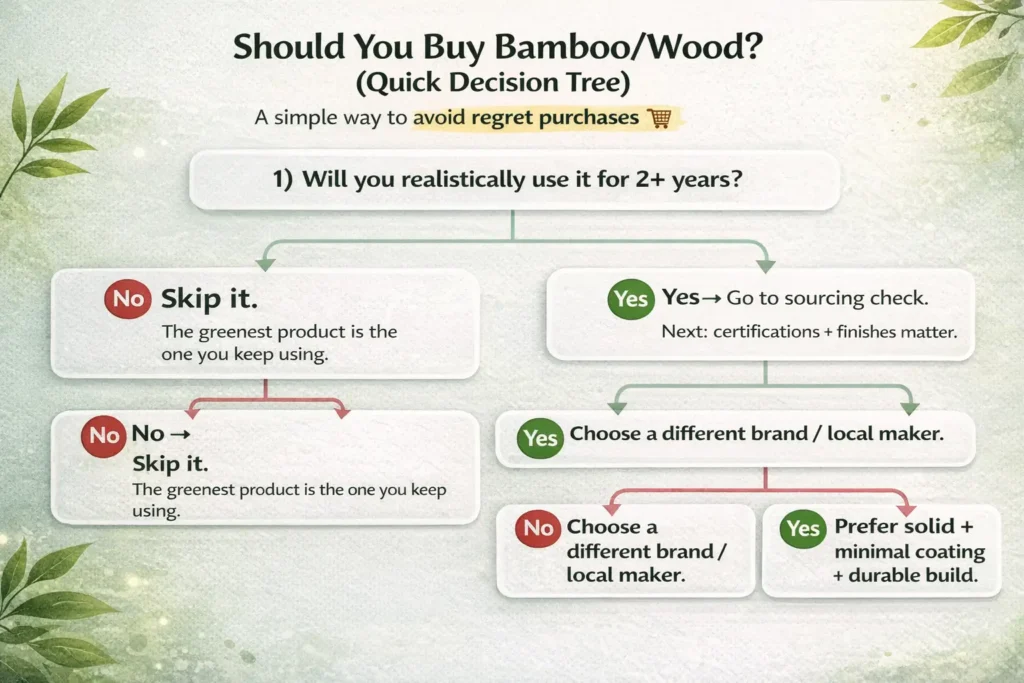
Final thoughts / Conclusion 🌿
Bamboo and wooden products can be genuinely sustainable but only when they’re responsibly sourced, sensibly processed, and actually used for a long time. The truth is: the material name alone (“bamboo” or “wood”) doesn’t guarantee eco-friendliness.
If you want a simple EcoNir rule to live by:
- ✅ Choose certified or clearly traceable wood/bamboo (FSC/PEFC when possible)
- ✅ Prefer solid, durable pieces over heavily laminated/glued ones
- ✅ Avoid strong chemical smells, thick glossy coatings, and “too cheap to be true” buys
- ✅ Buy less, buy better, and make it last (care matters!)
In the end, the most sustainable product isn’t the trendiest one it’s the one that fits your daily life so well that you keep using it happily, year after year.