
Why Wooden Products Are the Ultimate Future of Sustainable Living in 2026 (India + Global)
The first time I switched from plastic to wood, it wasn’t a “save the planet” moment—it was a small kitchen moment. I was cooking, the plastic spatula had started bending, and that faint plastic smell annoyed me more than I expected. I bought a simple wooden spatula from a local shop. It felt warmer in the hand, didn’t complain near heat, and somehow made the kitchen feel… calmer.
That’s the quiet power of wood: it doesn’t scream “eco.” It just fits.
In 2026, that personal feeling is becoming a global direction. Wooden products are the future of sustainable living in 2026 because they help us reduce plastic dependence, choose renewable materials, and build homes that last longer with less waste-especially when wood is sourced and finished responsibly.
Want to reduce household waste effectively? Read our complete guide on Zero-Waste Lifestyle: Practical Guide to Reduce Trash to get started today.
This EcoNir guide covers India-first realities (availability, common woods, local buying tips) while keeping it useful for global readers too.
Table of Contents
What “sustainable living in 2026” looks like
Sustainable living in 2026 is less about “perfect zero-waste” and more about practical systems:
- Reducing single-use plastics and unnecessary packaging
- Choosing materials that can last, be repaired, and be reused
- Buying fewer items, but buying better
- Thinking in cycles, not just bins (circular economy)
If you want the big-picture framework, this is a clear reference: circular economy overview (Ellen MacArthur Foundation).
And the pressure to reduce plastic is only growing globally. UNEP tracks the plastic pollution crisis and solutions here: plastic pollution information.
Wood fits this 2026 reality because it can be renewable, durable, repairable, and often a plastic-free alternative—but only when done right.
Start your green journey with How to Start Sustainable Living in India (Realistic Tips).
Are wooden products actually sustainable?
Wood is not automatically sustainable. A wooden item can be:
- sustainable (certified/reclaimed, durable, safe finish), or
- harmful (illegal logging, wasteful production, toxic finishes, short lifespan)
Think of sustainability like a recipe:
- responsible sourcing
- smart design (durability/repair)
- safe finishes
- long use
- responsible end-of-life
This is why “wood is better than plastic” is too simple. The real truth is:
Wooden products are the future of sustainable living in 2026 when they are responsibly sourced and built to last.
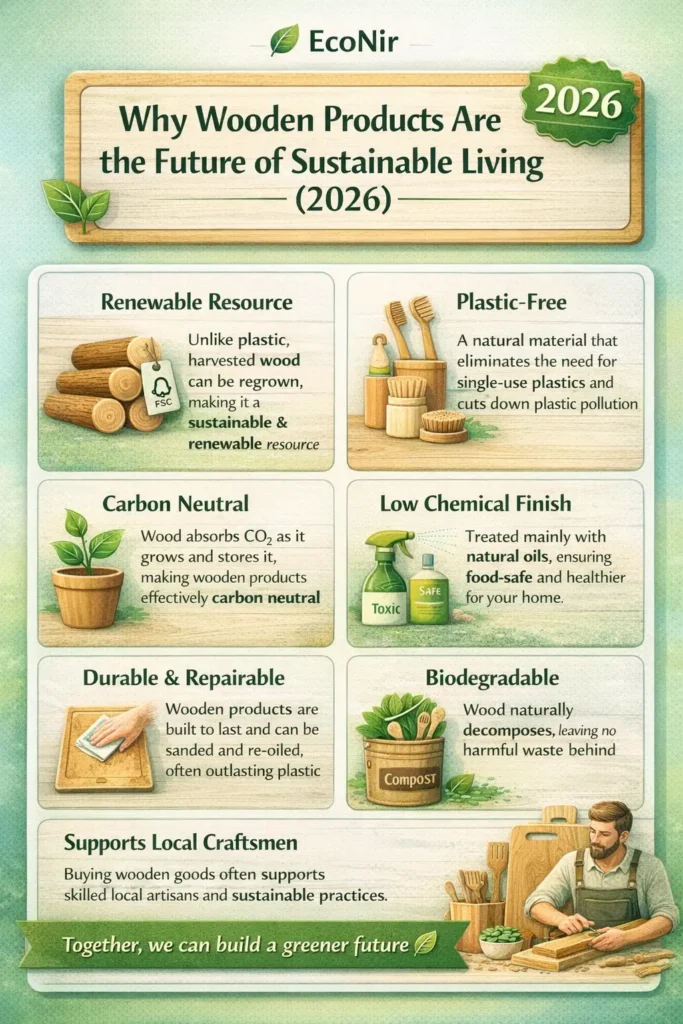
9 reasons wooden products are the future of sustainable living in 2026
1) Wood is renewable (when forests are managed well)
Plastic is typically fossil-based. Wood comes from trees—renewable if forests are managed responsibly.
Look for credible certification:
These don’t guarantee perfection, but they are stronger than vague labels like “eco wood” or “natural wood.”
2) Wooden products can store carbon in long-life use
Trees absorb carbon while growing. When wood becomes long-lasting products (furniture, shelves, décor, building materials), that carbon can remain stored for years.
This benefit depends on responsible forestry and what happens at end-of-life (reuse is best).
3) Wood supports a repair culture (a big 2026 shift)
In India, repair culture never fully died – carpenters, local workshops, and “thoda adjust kar lo” has saved more items than we realise.
Wood is naturally aligned with repair:
- sand it
- oil it
- re-finish it
- tighten joints
- replace a part (like a brush head)
That’s real sustainability: less replacement, less manufacturing, less waste.
4) It reduces everyday plastic dependence (without feeling extreme)
A lot of people want sustainability—but not a lifestyle that feels fragile or “all or nothing.”
Wooden alternatives are often easy:
- wooden spoons/spatulas
- wooden scrub brushes
- wooden combs
- wooden storage boxes
- wooden hangers
These are simple, quiet swaps that reduce plastic in daily touchpoints.
5) Wooden products are often safer around heat than cheap plastics
In kitchens, low-quality plastic tools can deform near heat and wear quickly. Wood handles heat better in many use cases (though it needs proper cleaning and drying).
6) Wood helps reduce “fast clutter”
One underrated sustainability problem in 2026: fast clutter—cheap items bought frequently that break quickly.
Wooden products (when well-made) resist this cycle because they’re designed to be kept.
7) Wooden alternatives are improving in packaging, design, and availability
More brands are moving toward paper/fiber packaging and plastic-free product design because consumers demand it and waste rules are tightening.
For basic waste prevention strategies, the EPA has a useful overview: reduce and reuse basics.
8) Wood fits “circular economy” thinking better than mixed plastics
Many plastic products are made of mixed materials that are difficult to recycle. Wood is easier to repair, repurpose, and (in untreated forms) can be biodegradable.
9) Wood brings emotional durability (yes, that matters)
This is personal, but it’s real: wooden items often feel like they belong. You don’t throw them away casually.
A wooden masala shelf, a spoon that’s darkened with years of tadka, a stool that’s been in the family—these things naturally create long use. Sustainable living in 2026 needs emotional durability as much as material durability.
Wood vs plastic vs steel vs glass
| Material | Best for | Strength (Sustainability) | Common downside | Best eco tip |
|---|---|---|---|---|
| Wood | utensils, brushes, furniture, décor | renewable, repairable, long life | needs responsible sourcing; some finishes/glues | choose FSC/PEFC or reclaimed; avoid toxic coatings |
| Plastic | select medical/technical uses | light weight | fossil-based; microplastics; short life | refuse single-use; buy durable only when necessary |
| Steel (stainless) | bottles, cookware, storage | very durable; recyclable | high energy to produce | buy once, maintain for years |
| Glass | jars, storage, pantry | inert; reusable | heavy (transport emissions), breakable | reuse jars you already have |
EcoNir takeaway: A practical sustainable home in 2026 often uses wood + steel + glass thoughtfully, and avoids single-use plastic wherever possible.
Best eco-friendly wooden products (high-impact swaps)
These are realistic swaps that work well in India and globally.
Kitchen (highest impact for most homes)
- Wooden spatula, spoon, ladle
- Wooden rolling pin (belan) and board (chakla)
- Wooden cutting board (with proper care)
- Wooden dish brush with replaceable head
- Wooden tray/organiser to reduce plastic clutter
Discover smarter choices in our guide: Eco-Friendly Kitchen Swaps That Actually Work.
Bathroom
- Wooden comb / hairbrush
- Wooden soap dish (helps soap last longer)
- Wooden toothbrush handle options (check bristle material)
Cleaning
- Wooden broom/brush
- Wooden scrub brush
- Reusable cloths + wooden storage hooks
Home & décor
- Solid wood shelves (repairable)
- Reclaimed wood side tables
- Wooden hangers (durable and plastic-free)
Kids & gifting
- Wooden puzzles/toys (often longer-lasting, hand-me-down friendly)
- Wooden stationary organizers for study tables
India guide: common wood types + what they’re best for
Availability varies by region, but these are commonly seen in India:
| Wood type (India) | Common use | Why people like it | Eco note |
|---|---|---|---|
| Sheesham (Indian rosewood) | furniture | strong, long life | sourcing matters—ask for legal supply |
| Mango wood | furniture, bowls | affordable, attractive grain | often a by-product of mango orchards (varies) |
| Neem | small items, storage | naturally resistant to pests | ensure safe finishing for food contact |
| Bamboo (grass) | brushes, organizers | fast-growing | processing/glues matter; not always “compostable” |
| Coconut wood | bowls, décor | uses older coconut trees | check quality + finish |
Tip (India): If you’re buying locally made wooden products, don’t feel shy asking simple questions:
- “Wood ka source kya hai?”
- “Finish kaunsa hai—food-safe?”
- “Repair ho jayega?”
A genuine maker will answer clearly. A greenwashing seller usually won’t.
How to buy responsibly (avoid greenwashing)
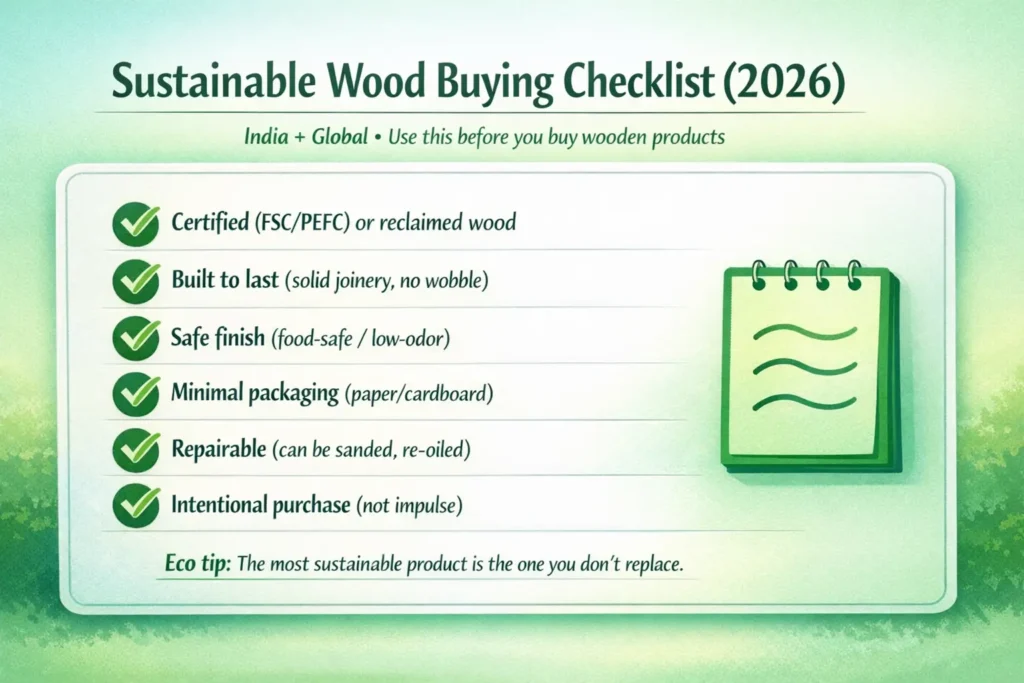
Step 1: Prefer certified or reclaimed wood
- FSC certified wood: FSC official site
- PEFC certified wood: PEFC official site
- reclaimed wood (old doors, old furniture, salvage markets)
Reclaimed wood (India reality): Old furniture markets and carpenter workshops can be goldmines. Sometimes the most sustainable piece is the one already in your city.
Step 2: Check glue + finish (especially for kitchenware)
For bowls, boards, spoons:
- prefer food-safe finishes
- avoid products with strong chemical smell
- avoid thick glossy coatings that chip easily
If you’re unsure, choose unfinished (and oil it yourself) or buy from makers who clearly mention food-safe finishing.
Step 3: Avoid “disposable wood”
Some wooden products are made so thin or poorly joined that they behave like disposable items. That defeats the purpose.
Look for:
- solid joinery
- smooth finishing
- no wobble, no cracks
- comfortable grip (you’ll use it more)
Step 4: Buy fewer items (the most sustainable rule)
In 2026, sustainable living is often more about refusing extra purchases than finding new materials.
Ask before buying:
- Do I already have something that works?
- Is this solving a real problem—or just adding “eco” clutter?
Step 5: Choose local artisans when possible
Local woodcraft supports livelihoods and often reduces shipping impact. It also makes repair easier because you can return to the maker.
Care + maintenance: make wooden items last for years
A wooden product becomes truly sustainable when it stays in your home for a long time.
For wooden cutting boards
- Don’t soak in water
- Wash quickly, wipe dry
- Dry upright
- Oil when surface looks dry (monthly or as needed)
For wooden spoons/spatulas
- Hand wash when possible
- Avoid long dishwasher cycles
- Oil lightly if they look dull or rough
For wooden furniture
- Use coasters/felt pads
- Dust regularly (grit scratches surfaces)
- Fix small damage early (cheaper than replacement)
This is the part I love most: caring for wood feels less like “maintenance” and more like keeping something alive in the home.
FAQs
1. Are wooden products always eco-friendly?
No. A wooden item is eco-friendly when the wood is responsibly sourced (FSC/PEFC or reclaimed), made to last, and finished safely.
2. Which wooden products make the biggest difference in a typical Indian home?
Kitchen and cleaning tools usually give fast results: wooden spatulas, dish brushes, storage organizers, and solid wood furniture you can repair.
3. Is bamboo better than wood?
Bamboo grows fast (good), but it can involve processing and glues (not always good). Treat bamboo like wood: check sourcing, finish, and durability.
4. How do I avoid greenwashing while buying wooden products online?
Look for clear sourcing info, certifications, material details, finish details, and realistic care instructions. Avoid listings that only say “eco-friendly” without proof.
🔎 What We Learned: The real reason wood wins in 2026
In 2026, sustainability isn’t only about finding “green products.” It’s about building a home that produces less waste because the things inside it are repairable, long-lasting, and chosen intentionally.
Wooden products support that future—especially in India, where local makers and repair culture still exist, and globally where plastic reduction is becoming non-negotiable.
If you want one simple starting point: replace one plastic tool you keep re-buying with a well-made wooden version, then care for it properly. That’s how sustainable living becomes real-quietly, over time.